19/10/2026 19:40
Basket or Bike Light? Compare YouTube Demos Before Promoting a Cambodian Bicycle Shop

A bicycle basket demonstration attracts attention, while a quieter bike-light video brings questions about mounting brackets. Which should your shop promote next? The answer depends on what you want the next video to accomplish. A Cambodian bicycle business needs more than a ranking of its most-viewed uploads: it needs a fair comparison that connects the content to a practical customer question. This workflow uses YouTube Analytics alongside a small enquiry record to help you choose between two demonstrations. It also explains where SMM panel service claims belong in the review, without treating purchased engagement as evidence of genuine interest, sales, advertising delivery or Cambodian viewers.
1. Choose the business decision before opening analytics
Begin with a decision you can actually make this week. For a bicycle shop, that might be choosing whether the next filming session should explain basket clearance or light-bracket compatibility. Avoid starting with the vague aim of finding your best video. A video can be useful for attracting curiosity, answering fitting questions or supporting an existing customer, and those purposes need different judgments.
In a hypothetical Phnom Penh shop, the owner has time to produce one follow-up demonstration. Both baskets and lights are available, but customers often arrive without knowing whether an accessory will fit. The owner writes a simple question: which demonstration gives us the clearest reason to make another fitting guide? That question keeps the review focused on useful information rather than a contest between visible counters.
2. Select two videos that are reasonably comparable
Choose videos with similar presentation conditions where possible. Compare two ordinary demonstrations spoken in Khmer, filmed for the same type of customer and offering a similar next step. Record differences in length, upload date, product availability and how each video was shared. You do not need perfect matching, but you do need to know what could explain the difference.
Comparing a short basket reveal with a detailed light-installation lesson would mix several questions together. The reveal may invite quick curiosity; the lesson asks for sustained attention. You can still review both, but you should not conclude that the accessory alone caused the result. If your library has no suitable pair, use the exercise to design the next pair more consistently instead of forcing a winner.
3. Give each demonstration a fair observation window
An older upload has had longer to collect activity. Decide whether you are comparing equivalent periods after publication or the same recent calendar period. The first approach helps assess an upload's early response; the second helps decide which existing resource is useful now. Write that choice above your notes so the team does not switch interpretations halfway through.
YouTube's official Advanced Mode tips describe comparisons across the first 24 hours, seven days or 28 days of videos' lifespans. For this hypothetical shop, the first seven days could be a practical initial review window, followed by another review later. This is an editorial choice, not a universal success threshold. If one video has not completed the chosen window, wait before comparing it. See YouTube's official comparison guidance: https://support.google.com/youtube/answer/16766491?hl=en.
4. Open a comparison you can reproduce
On a computer, open YouTube Studio, select Analytics and enter Advanced Mode or See More. Select the first video, use Add comparison for the second, and check the dates and metrics. YouTube notes that its Studio interface is changing, so positions may differ. Its official instructions are here: https://support.google.com/youtube/answer/9717005?hl=en.
Keep your first review small. Note views, watch time and average view duration where available, then inspect traffic-source differences. Record the video titles, links, selected period and review date. Save the report or export the current view if useful. These settings make the comparison reproducible; they do not establish why a result occurred.
Ask a colleague to read your notes without your explanation. They should be able to identify the two videos and the exact question under review. If they cannot, simplify the record before adding more measurements.
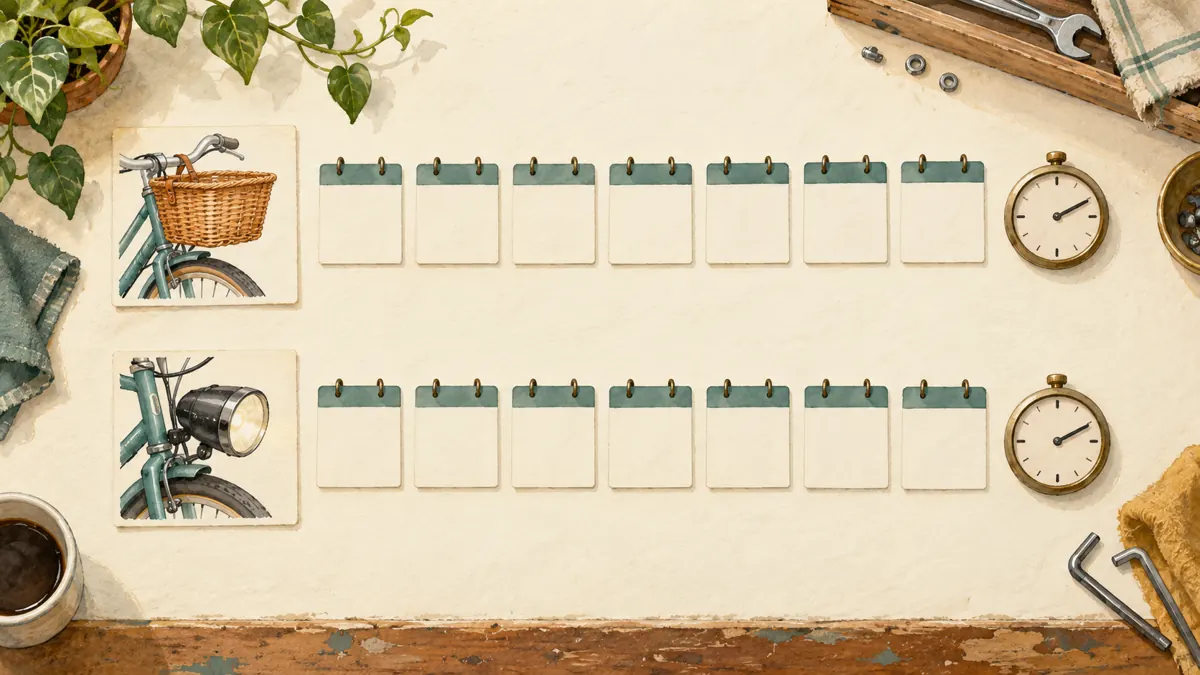
5. Interpret the measurements together
Use views to understand the scale of recorded viewing activity, then examine how much viewing accompanied it. A longer demonstration can accumulate more watch time partly because it offers more material. A shorter one may communicate its central point quickly. Neither observation, by itself, tells you which accessory customers intend to buy.
Traffic context also matters. In a hypothetical comparison, the basket video was shared with an existing cycling community, while the light video circulated through the shop's usual channels. Different responses could reflect those audiences as well as the videos. Record the sharing difference rather than attributing everything to the product or opening shot.
Treat an unusual result as a question to investigate. Watch the relevant demonstration yourself: is the fitting detail visible, is the explanation accurate, and does the viewer know what information to send the shop? Analytics can help choose where to look; the content review explains what you might improve.
6. Keep a separate record of genuine fitting enquiries
Create a small enquiry log alongside the video comparison. Record the accessory discussed, the customer's practical question, whether they mentioned a particular video, and the next action. Useful questions include whether a basket clears the brake cables or whether a light bracket fits the available handlebar space. Keep personal contact details in the normal customer system rather than copying them into an editorial report.
Ask naturally how the person found the demonstration when that information would help. If they do not know, mark the source as unknown. A message arriving after an upload does not establish that the upload caused it. Someone might have found the shop through a friend, an earlier visit or another social post.
For Cambodian businesses serving several locations, also distinguish product interest from service feasibility. A fitting request from outside your service area is still informative, but it may call for clearer collection or delivery information rather than more promotion.
7. Put SMM catalogue claims through a separate review
The supplied public catalogue includes the exact service name "Youtube ~ Adwords Views ~ Min 1M ~ Super Fast ~ 𝐋𝐢𝐟𝐞𝐓𝐢𝐦𝐞 ~ INSTANT" under a YouTube Adwords views category. Its description is empty. The name identifies a listing to investigate; it does not establish how delivery works, whether an advertising campaign exists, who sees the video or what documentation a customer receives.
Before considering such a listing, request a clear explanation of the delivery method and evidence supporting any advertising claim. Do not infer Google or YouTube affiliation from the wording. An order record and a change in a video's counter are different records, and neither alone proves Cambodian audience interest or a sale.
YouTube prohibits artificial inflation of views, likes, comments and other metrics, and says a hired promoter's actions can affect the channel. Reject methods that conflict with that policy. Keep policy checks separate from catalogue marketing language: https://support.google.com/youtube/answer/3399767?hl=en-GB.
If an earlier video had outside promotion, document the known method and timing before comparing it. Do not buy engagement to make the two samples appear balanced; that would make the customer-interest question harder to answer.

8. Turn the comparison into one filming decision
In a hypothetical outcome, the basket demonstration receives more viewing activity, but the light demonstration prompts specific questions about bracket fit. The owner might choose a close-up light-mounting guide because it addresses an unresolved buying obstacle. This is a reasoned editorial choice, not proof that lights are more popular across Cambodia.
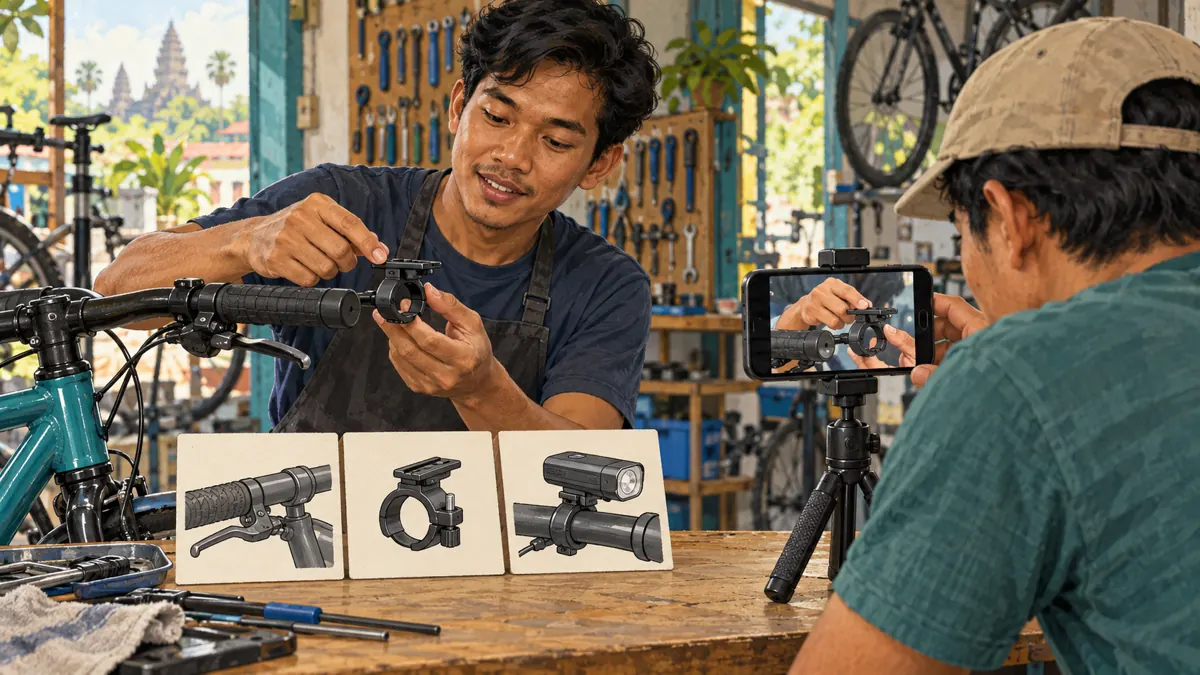
Write the next filming brief around that obstacle. Show the mounting space clearly, identify the accessory demonstrated, explain which details the shop needs to assess compatibility, and avoid implying that one bracket fits every bicycle. End with a useful request: send a clear handlebar photo through the shop's established contact route.
Make one principal change so the next review stays understandable. If you change the presenter, language, topic, length and distribution at once, any difference will be difficult to explain. A focused follow-up builds knowledge even when it does not produce an obvious winner.
9. Recognize when the right decision is to wait
Sometimes the comparison is too weak to support a choice. There may be little activity, incomplete observation windows or no genuine enquiries connected to either demonstration. Record that uncertainty directly. You can still select a topic based on recurring questions at the counter, stock readiness and the team's ability to demonstrate it accurately.
Another reason to pause promotion is a mismatch between the video and current shop operations. If the featured basket is unavailable or the fitting service has changed, attention may create avoidable confusion. Resolve the product information first. The most useful next action could be updating the explanation, filming the available alternative or clarifying who can obtain fitting assistance.
10. Avoid mistakes that make the comparison misleading
Do not compare lifetime totals for an established upload against a new release and call the larger number proof of stronger demand. Do not change the review window only because another period gives your preferred video a better result. Agree on the question and observation period before reading the outcome.
Avoid counting every comment as a fitting enquiry. Praise, repeated promotional text and unrelated questions have different meanings. Likewise, a Cambodian location mentioned in a message does not establish the origin of all viewers. Keep each conclusion as narrow as its evidence.
Finally, do not rewrite uncertainty into confidence for a management report. A useful closing note says what was observed, what remains unexplained and what the shop will test next. Assign someone to film the follow-up and set the next review date. That turns the comparison into a working content process.
Frequently asked questions
What if the higher-viewed video produces no identifiable enquiries?
Treat it as evidence of viewing activity, with the business outcome still unresolved. Review whether the demonstration answers a useful question and gives a clear next step. Some viewers may act later or contact the shop without identifying the video. Do not invent attribution, but do not assume that an untracked enquiry means the video had no value.
Can we compare a basket Short with a longer installation video?
You can review both as parts of your content plan, but they are a weak pair for deciding which product topic works better. Their length and viewing purpose differ. For a cleaner topic comparison, choose similar demonstrations. Otherwise, assess each against its own job, such as introducing the accessory or explaining compatibility.
How many views are enough to make a decision?
There is no universal number that makes a small shop's comparison reliable. Look for a completed review window, reasonably comparable conditions and observations that recur rather than appearing once. With limited evidence, make a modest content decision that is inexpensive to revise. Avoid turning a tentative observation into a broad claim about Cambodian customer preferences.
Does a panel listing with Adwords in its name prove advertising delivery?
No. A catalogue label alone does not verify a campaign, targeting, delivery method or platform relationship. Ask for supporting documentation and assess the method against YouTube's rules before proceeding. Keep any service delivery evidence separate from analytics and customer enquiries; none of those records automatically proves the others.
What should a small team retain after the review?
Keep a short decision record containing the two video links, the comparison period, important differences, the observed pattern and the next filming action. Add an anonymized summary of relevant enquiries and a review date. This gives the next person enough context to continue the work without circulating customer details or repeatedly reopening every report.
Explore the current service catalogue, create an account, or ask a specific question through support tickets.
- YouTube Help: Learn how to use Advanced mode for analytics reports
- YouTube Help: Tips for Advanced Mode on Analytics
- YouTube Help: Fake engagement policy
Prepared with AI assistance. Illustrations explain the workflow and do not represent customer results.